College Planning Resources to Help you Learn More
Diversified College Planning
Is the college system working for your family?
Most families don’t know what they don’t know — and it costs them. Take this 15-question quiz to find out how the system really works, and what strategic families do differently.
Question 1 of 15
Your next step
See exactly what the system looks like for your family.
In a free 30-minute session we’ll show you your Student Aid Index, where your student stands academically at every school on your list, and what the net cost looks like — before a single application goes out.
Book your free strategy session →No obligation. No pressure. 100% money back if you decide not to proceed.
Strategic College Positioning – Accepted vs Recruited
College Planning Resources to Help You Learn More
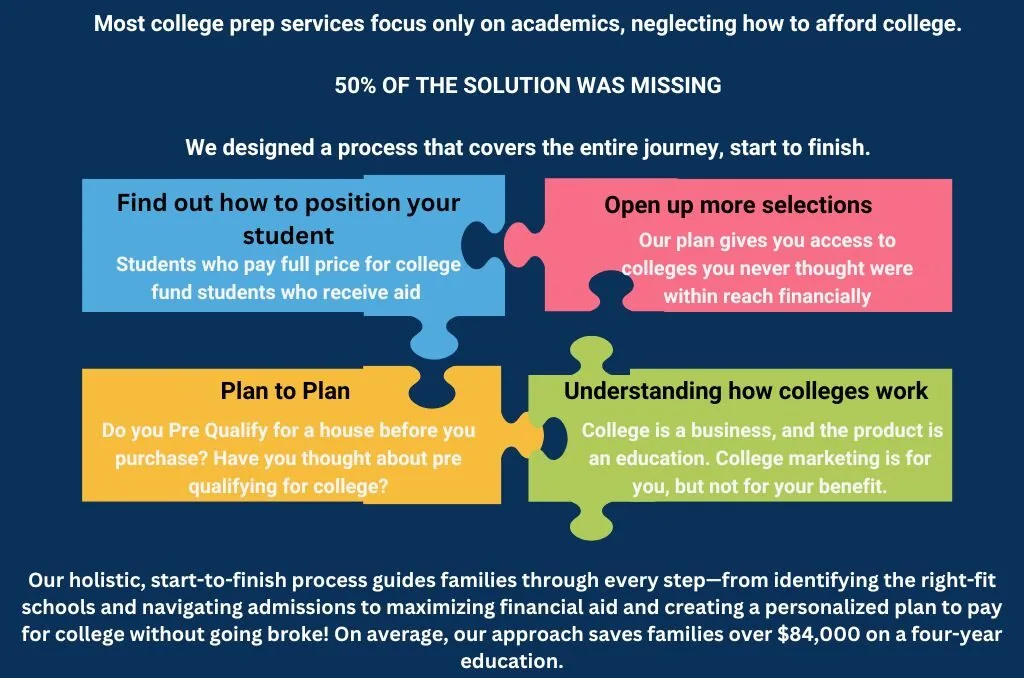
Most families treat college planning as a checklist — pick some schools, fill out the FAFSA, wait and see. What they don’t realize is that colleges have already been planning for them. Schools use sophisticated enrollment management systems, financial aid algorithms, and institutional data to build a class that serves their interests. Families who don’t understand that dynamic consistently overpay.
The resources below aren’t just informational — they are the specific tools we use inside our planning process to position students for maximum institutional support. Each one addresses a lever that directly affects how much your family pays. Used together, they form a complete strategy. Used in isolation, they’re just information.
This is how we turn information into savings.
Seven levers, one strategy
Student Aid Index
Your Student Aid Index is the single most important number in the financial aid process — and most families don’t calculate it until after they’ve already filed the FAFSA. By then, it’s too late to do anything about it.
Understanding your SAI in advance tells you exactly which lane you’re in: need-based aid or merit aid. If your SAI falls below a school’s cost of attendance, you have demonstrated financial need — and the strategy is to find schools with the endowment and commitment to meet it. If your SAI exceeds the cost of attendance, there is no need at that school regardless of how expensive it feels to your family. That means the entire strategy shifts to merit positioning.
Read the full article →Career Assessment Tools
The goal isn’t to hand a student a career and tell them what to do. It’s to build a profile complete enough that when we start evaluating schools, we’re not guessing. A school that’s a strong academic and financial fit but a complete mismatch for who the student is will likely cost you a fifth year — or worse, a transfer.
The Focus 2 assessment is one of the first tools we use because everything downstream — major selection, school list building, and financial strategy — works better when it starts with an honest picture of the student.
Read the full article →College Selection / Student Positioning
Many families assume college financial aid is simple: fill out a few forms, submit applications, and let the system work. Unfortunately, that mindset is exactly why so many families overpay. Financial aid is not just paperwork — it is strategy. And without a clear plan, small mistakes can quietly cost you thousands over four years.
Here are eight mistakes that can sabotage your financial aid strategy — and what you need to understand to avoid them.
Filing FAFSA and CSS Profile
Most families have heard of the FAFSA. Far fewer truly understand the CSS Profile. And almost no one realizes that many colleges also require their own institutional financial aid forms on top of both.
If these three layers do not align properly, your file can be flagged for verification — which is essentially the college version of a financial audit.
Understanding how these forms work together is not optional if you want to protect aid eligibility. It is foundational.
Read the full article →Awards & Appeal
Receiving a disappointing financial aid award can feel final — but in many cases, it’s only the beginning of the conversation. We regularly tell families: “Typically — not always — the worst offer is the first offer.” Colleges operate as businesses. Their product is education, and financial aid is one of the primary tools they use to shape their incoming class. Awards are influenced not only by financial need, but by enrollment targets, academic profile goals, geographic diversity, and competition from peer institutions. Many schools build flexibility into their aid budgets, but they rarely increase an award unless a family presents a strategic and well-supported case.
Read the full article →Test Prep
At many colleges, standardized test scores are directly tied to merit scholarship thresholds. A student who scores 100–200 points higher may jump from one award bracket to the next — sometimes unlocking $10,000 to $20,000 more per year in institutional aid. Over four years, that’s a life-changing difference.
Even at test-optional schools, strong scores can open doors to honors programs, competitive academic tracks, and scholarship consideration that the school quietly reserves for students who submit. Our in-house Tutor Space platform was built specifically to help students reach the score thresholds that trigger meaningful awards at the schools on their list — not just any schools, but the specific schools where their academic profile earns them financial leverage.
Test prep isn’t about getting into college. It’s about getting paid to go.
Read the full article →Social Media Strategies
Colleges don’t just review transcripts and essays anymore. Admissions and enrollment management teams increasingly evaluate a student’s digital presence as part of a holistic review — and what they find can influence both admission decisions and scholarship consideration.
But a managed digital footprint isn’t just about avoiding red flags. It’s an active tool for demonstrating interest. Colleges track demonstrated interest carefully because yield — the percentage of admitted students who enroll — is a critical institutional metric. A student who follows a school, engages with its content, and builds a visible academic identity online signals to that school’s enrollment team: this student fits us and wants to be here. That signal matters when scholarship dollars are being allocated.
Read the full article →
Merit Aid and High Income Earners
The Emotional Trap and Your Student Aid Index
Need Aid and Middle To Lower Income Earners
How College Searches Should Be Done
College Planning from the Top Down
Think Need Aid is the Only Option?
Our Trusted Loan Broker Partner

Houston White
Senior Loan Officer
Neighborhood Mortgage Inc
1835 Lockeway Dr, Suite 306
Alpharetta, GA 30004
Phone: (470) 533-8955
Email: houston@nloans.net
NMLS: 1732667 | Company NMLS: 138234
Have Questions About College Planning?
We’re Here to Help Every Step of the Way
Choosing the right college and the best financial strategy can feel overwhelming—but you don’t have to do it alone. Our team at Diversified College Planning is here to guide you through the entire process, from pre-qualifying for aid to finding schools that are both academically and financially the right fit. Let’s build your customized plan together.