Most families ask WHERE can my student get accepted. We dive deeper and help families understand WHY their student is getting accepted.
These are two very different questions
Helping families save an average of $84,000 on college by using our proprietary data you can’t find anywhere else.
As a forward thinking, family-owned business since 1980, we’ve helped over 30,000 families save an average of $84,000 on their children’s college education—using a one-of-a-kind strategy you won’t find anywhere else.
By The Numbers:
Average we save families on the cost of a 4YR degree
Students helped
Financial Aid awarded
National Avg time to graduate
National Avg Graduation Rate
Our Graduation Rate








Why diversified college planning
Colleges are businesses. They make strategic enrollment decisions—whether your family understands them or not.
Most families are told the path to college is simple: earn a high GPA, score well on the SAT or ACT, build an impressive résumé, and submit great applications. Others believe the answer is simply saving more money for tuition.
What most families are never told is this:
1200
SAT score
Accepted1400
SAT score
DeniedSame college. Middle 50% SAT range of 1200–1450. Two students, two outcomes — and the higher score didn’t win.
Because college admissions isn’t just about who has the highest GPA or test scores. Colleges are building a class. They have enrollment goals, institutional priorities, financial objectives, and academic needs that influence every admission decision.
The question families ask
“Is my student qualified?”
The question that actually matters
“Why would this college accept my student?”
At Diversified College Planning, we help families answer that question before applications are submitted. By understanding how colleges make enrollment decisions, we position students to become stronger candidates for admission, maximize merit or need-based aid opportunities, and identify colleges where they are most likely to be recruited, rewarded, and successful.
That’s where we come in.
Diversified college planning
Our holistic, start-to-finish process guides families through every step—from identifying the right-fit schools and navigating admissions to maximizing financial aid and creating a personalized plan to pay for college without going broke.
Client family file — net price comparison
An actual client outcome. Individual results are not guaranteed and may vary based on your student’s profile and target schools.
College funding and traditional financial planning are often treated as the same thing—but they are very different disciplines.
A strong retirement plan does not automatically mean a family is prepared for college costs. In fact, many families discover too late that the way their money is saved can actually reduce financial aid eligibility or limit scholarship opportunities.
Most financial advisors are trained to focus on retirement planning and investment management. The college admissions and financial aid system is a separate and highly specialized area that many advisors do not fully understand.
For example
- 01Do they know what the Student Aid Index (SAI) is and how it affects your financial aid eligibility?
- 02More importantly, do they know legal strategies that can help lower your SAI?
- 03Do they understand how assets and income are treated on FAFSA, CSS Profile, and institutional financial aid forms?
- 04With more than 4,000 universities in the United States, do they know what counts against you—and what does not—within each school’s financial aid formulas?
- 05Have they created a strategy that allows you to pay for college while also protecting certain assets from financial aid calculations when legally possible?
Most advisors simply have not been trained in these areas because college planning requires a completely different skill set.
Beyond understanding the forms themselves, families must also navigate:
What we manage for your family
- ✓FAFSA and CSS Profile filing strategies
- ✓Institutional financial aid forms required by many private colleges
- ✓Understanding whether a college primarily awards need-based aid, merit-based aid, or both
- ✓Financial aid appeals and reconsideration requests
- ✓Leveraging competing financial aid offers from multiple schools
- ✓Structuring assets in ways that protect aid eligibility when possible
The challenge is that this process changes frequently, and each college may apply its own methodology when awarding institutional aid.
That is why specialized college planning matters.
At the end of the day, getting accepted to a college is only half the equation. The real goal is ensuring that the school your student attends is both the right academic fit and financially sustainable for your family.
The truth is simple: this is the advice most families receive.
“Apply to the schools you love. Hope you get accepted. Then figure out how to pay for it.”
It sounds reasonable. Unfortunately, it is exactly what leads so many families into financial hardship and missed opportunities.
$1.8T
student loan debt
That approach has contributed to this figure. It is also one of the reasons the average student doesn’t earn a bachelor’s degree in four years. Nationally, the average time to complete a degree is now more than six years.
Source: Federal Reserve, National Center for Education Statistics
The college admissions system isn’t random, and it isn’t designed around what is best for your family. Colleges are making business decisions every day. Until families understand how those decisions are made, they will continue making one of the largest financial commitments of their lives without the information they need to make it wisely.
Local High School Partners








The 7 pillars of smarter college planning
Click any pillar to see how it changes the way your family should think about admissions.
Find where your student is positioned to succeed—not just where they can get accepted.
- Academic fit comes first.
- Success leads to higher graduation rates, better GPAs, stronger internships, and a better college experience.
- The goal is to graduate in four years.
Understand the difference between getting in and being wanted.
- Acceptance is not recruitment.
- Merit aid, honors programs, and special invitations indicate a school is recruiting your student.
- Full-pay acceptance often means you’re filling a seat, not being actively pursued.
Every admissions decision is also a business decision.
- Colleges manage tuition revenue, rankings, enrollment, and graduation rates.
- Families should understand the financial incentives behind admissions.
- Make your decision like a business owner, not just an emotional buyer.
Look for colleges that value your student enough to invest in them.
- Merit aid is a signal of value.
- Schools paying your student are often the schools where they’ll be most successful.
- Don’t chase colleges—find colleges that are chasing your student.
The goal isn’t admission—it’s graduation.
- A four-year graduation saves money and accelerates a student’s career.
- Academic alignment reduces the risk of major changes, academic struggles, and extended time in school.
- Two extra years of college can cost tens of thousands of dollars.
Buy value, not a bumper sticker.
- A recognizable name doesn’t always produce the best outcome.
- Focus on return on investment, career opportunities, and financial freedom.
- The best college is the one that creates the strongest long-term outcome.
Use facts to drive the decision, not feelings.
- Rankings and reputation shouldn’t outweigh student outcomes.
- Compare graduation rates, merit aid, academic fit, career placement, and total cost.
- The smartest college decision is based on evidence, not emotion.
Reverse engineering how colleges make decisions rather than simply picking schools families hope will work.
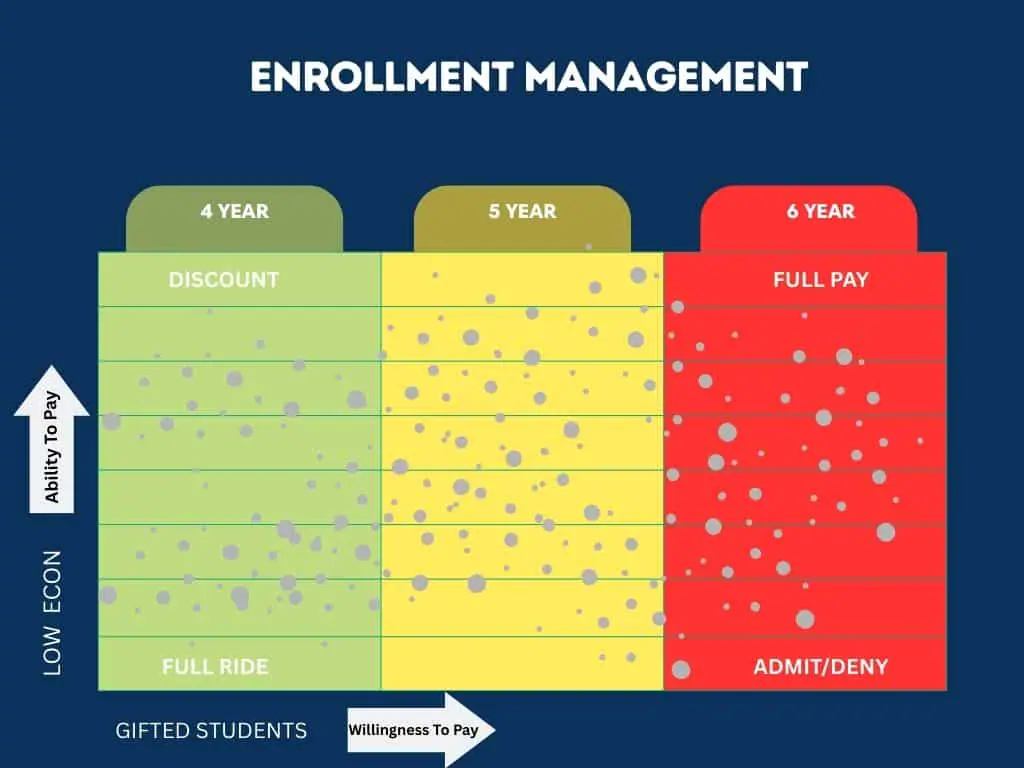
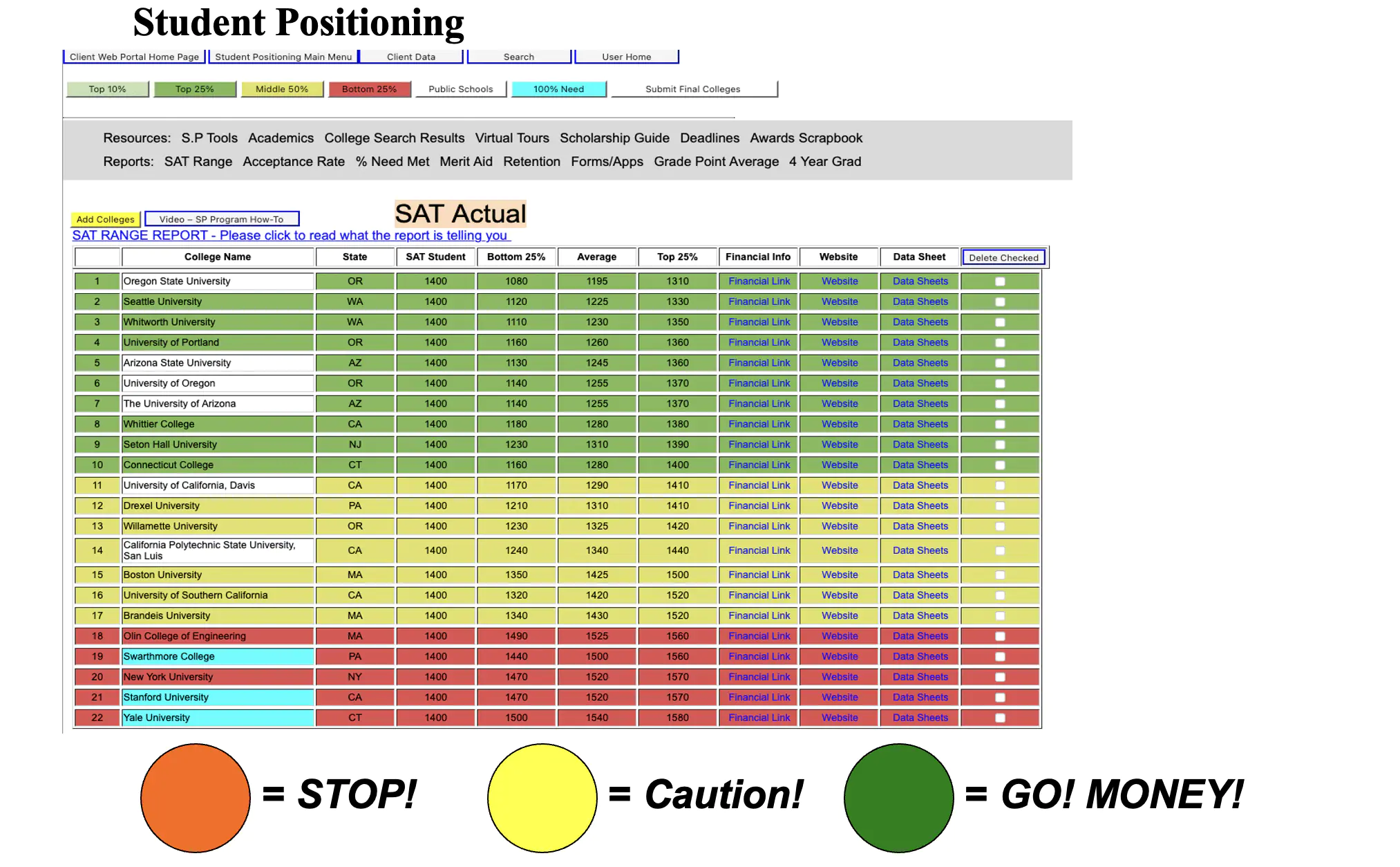
Use our reports to help find merit aid, need-based aid, retention rates, acceptance rates, 4-year graduation rates, and schools that fit the criteria most important to your student. You’ll save precious time (AND MONEY), and your student will avoid the heartache of applying to schools they’re unlikely to get into or can’t afford to attend.
Guarantee
We believe in our process so strongly that we guarantee it: if we can’t help your family save at least three times your investment, we’ll refund your money—no questions asked.


Helping Families Overcome Common Dilemmas.
Myth vs. Reality